Annual stars are a weather report, not a renovation plan
Every Chinese New Year, the nine flying stars move to new positions on the nine-grid chart of your home. The internet treats this as a major event — '2026 Flying Star Guide: Avoid These Sectors or Face Disaster!' The reality is less dramatic. Annual stars are a temporary overlay on your home's permanent Flying Star chart. They are like a weather report: worth checking, not worth rebuilding your house over.
The annual stars move in a fixed pattern. Each star takes one step each year, following a specific sequence. The stars that matter most are the 5 Yellow (五黄煞) and the 2 Black (二黑病符), which are considered the most challenging, and the 8 White (八白) and 9 Purple (九紫), which are considered the most favourable. The other five stars exist, but they are milder and rarely worth rearranging furniture for.
The nine stars: what each means when it visits a sector
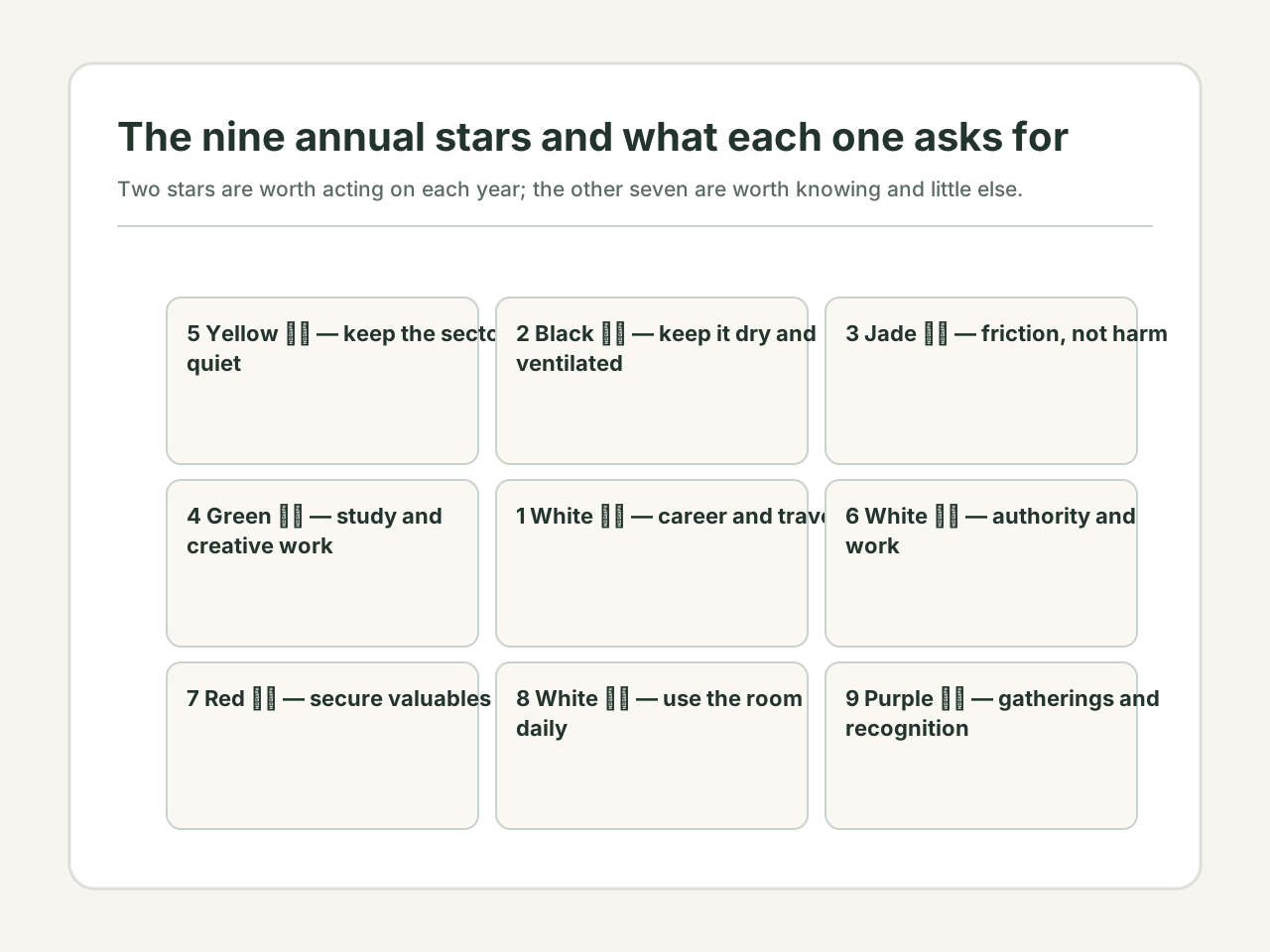
The annual stars are the same nine numbers as the permanent Flying Star chart, but their meaning is simplified because they are temporary. Here is the honest version of what each star means when it lands in a sector of your home for a year:
| Star | Name | Nature | Practical response |
|---|---|---|---|
| 1 | White Water (一白贪狼) | Mildly favourable — associated with career, travel, and communication | No special action needed. Use the sector normally. If you have a home office in a 1-star sector, it is a mild bonus. |
| 2 | Black Earth (二黑巨门) | Challenging — associated with illness and stagnation | Keep the sector clean, dry, and well-ventilated. Add metal elements (white, grey, metallic objects) to weaken the earth energy. Avoid noisy renovations in this sector. |
| 3 | Jade Wood (三碧禄存) | Argumentative — associated with conflict, disputes, and legal issues | This star is more about interpersonal friction than physical harm. If the 3 star lands in your living room, be aware that discussions may get heated. Add red accents (fire drains wood) to soften the energy. |
| 4 | Green Wood (四绿文曲) | Mildly favourable — associated with study, creativity, and romance | A good star for a study or creative workspace. The effect is subtle. No special action needed. |
| 5 | Yellow Earth (五黄廉贞) | Most challenging — the strongest negative star in any year | Keep this sector quiet. Avoid renovations, loud activities, and prolonged occupancy. Add metal elements to weaken the earth. If this sector is your bedroom, add metal wind chimes or a white rug. |
| 6 | White Metal (六白武曲) | Mildly favourable — associated with authority, career, and travel | No special action needed. A 6-star sector is a fine place for a home office or study. |
| 7 | Red Metal (七赤破军) | Potentially challenging — associated with theft, loss, and disputes | The 7 star is more about small annoyances than major problems. Keep valuables secure. Avoid leaving cash or important documents in this sector. |
| 8 | White Earth (八白左辅) | Favourable — associated with wealth and prosperity | Use this sector actively. It is a good spot for a living room, dining area, or home office. The star benefits from being in a room that is used daily. |
| 9 | Purple Fire (九紫右弼) | Favourable — associated with celebration, recognition, and future prosperity | Use this sector for gatherings, celebrations, and creative work. It is a good sector for a living room or dining area. The effect is stronger if the sector is already positive in your permanent chart. |
The two stars worth paying attention to every year
If you only remember two things about annual flying stars each year, remember these:
- Know where the 5 Yellow (五黄) is. The 5 star is the strongest negative influence in any year. The traditional advice — keep the sector quiet, avoid renovations, avoid spending too much time there — is sound. If the 5 star lands in a room you use daily, add metal elements (white, grey, metallic objects, a six-rod metal wind chime) to drain the earth energy. Do not panic. The 5 star is temporary, and its effect is diluted if the rest of your home is well-maintained and your permanent chart is balanced.
- Know where the 2 Black (二黑) is. The 2 star is associated with illness and stagnation. The practical response is the same as for the 5 star: keep the sector clean, dry, and ventilated. Add metal elements. The 2 star is weaker than the 5 star, so it is less urgent, but it is still worth knowing where it is, especially if someone in the household has health concerns.
A worked example: annual stars in a Period 8 home, 2026
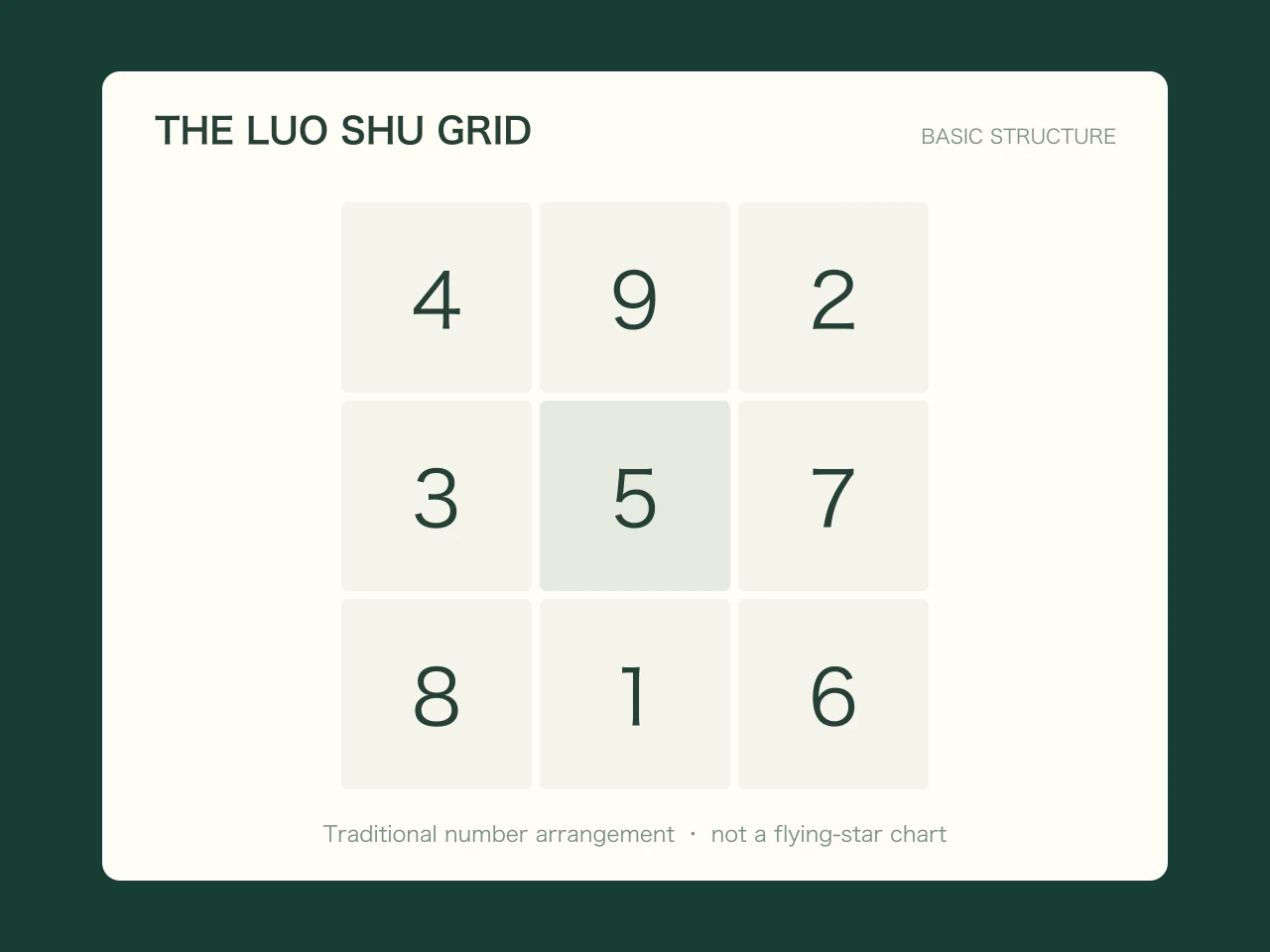
A family lives in a Period 8 home facing North. The annual layer is fixed before it ever touches the house. For 2026: 2+0+2+6 = 10, then 1+0 = 1, and 11 − 1 = 10, which reduces to 1, so 1 White takes the Centre. From there the nine palaces fill in the Luoshu order, which puts 2 Black in the Northwest, 4 Green in the Northeast, 5 Yellow in the South, and 8 White in the East. So in 2026 (Year of the Horse) the annual 5 Yellow star lands in the South, and the annual 2 Black star lands in the Northwest. The permanent chart underneath does not move: it still carries the mountain star 9 and water star 7 in the Northeast, and the base star 8 in the Centre.
The South is the main bedroom — the brightest room in the house and the one the parents are in every night. The annual 5 Yellow arriving here is the year's awkward placement, because the instruction and the habit point in opposite directions: the sector you are told to leave alone is the sector you cannot leave alone. The response is to stop the work, not to empty the room. The parents had been planning to re-tile the ensuite; they postpone it to 2027, when the 5 Yellow moves to the North. They keep sleeping there, keep the room ventilated, and let the renovation wait.
The Northwest is a laundry alcove off the kitchen that nobody sits in. The annual 2 Black there is the easier of the two problems, because this instruction is mostly about what you do in a sector rather than what you build in it: keep it clean, dry and ventilated, and add metal. The family hangs a small metal wind chime on the hook where the damp shows worst, and wipes the extractor fan filter twice a month. Effort: five minutes a month, plus one metal chime from a hardware shop.
The East is the breakfast corner, and it is the sector the 8 White rewards most. The annual 8 White lands there in 2026, but the corner has been unused since the move — the family eats standing at the kitchen island. So this one is not a case for restraint. On a Sunday afternoon they move a second-hand breakfast table and two stools into the East corner, and the 8 White goes from a number on a chart to a room with a purpose. The Northeast tells the opposite story: the annual 4 Green lands exactly where the permanent chart already puts the mountain star 9 and water star 7, in the bedroom the son uses as a study. Study and writing is what the 4 Green is traditionally asked for, and the request lands in a sector the permanent chart already rates well. Nothing changes there. The desk lamp stays where it is.
Total cost of the annual adjustments: one metal wind chime, one second-hand breakfast table with two stools, one postponed ensuite tiling. Total time: an afternoon for the table, five minutes a month for the chime. The family does not move out of the bedroom and does not repaint a single wall. The annual stars are a weather report, not a renovation plan — but it is worth reading the report before you schedule the year's work.
The practical boundary of annual flying stars
Annual flying stars are a real layer of Xuan Kong feng shui with a clear mathematical basis. They can be a useful annual check-in — a reason to look at each room of your home with fresh eyes and ask whether it still feels right. But the annual stars are temporary, subtle, and secondary to the permanent chart, which is itself secondary to the physical condition of your home. A clean, bright, well-maintained home with a 5-star sector is better feng shui than a neglected, dark home with a perfect annual star layout. Do not let annual star charts become a source of anxiety. If you enjoy the ritual of checking the stars each year, do it. If it stresses you out, skip it. Your home will be fine either way.
Disclaimer: This content is for informational and cultural reference purposes only. It does not constitute professional medical, legal, financial, or psychological advice. Readers should exercise their own judgment and consult qualified professionals for specific concerns.
Sources and review basis
Traditional references explain historical vocabulary and context. Official practical sources support only the observable safety, comfort, or environmental points noted in the article; they do not validate metaphysical claims.
Traditional reference
Huangdi Zhaijing (黄帝宅经)Wikisource digital text · Accessed 2026-07-14
Historical context for traditional residential orientation and spatial vocabulary. Modern recommendations are judged against real conditions.
Practical source
APA Dictionary of Psychology: Barnum effectAmerican Psychological Association · Accessed 2026-07-14
A psychology reference for why broad, favourable personality descriptions can feel personally accurate. It does not evaluate BaZi calculations themselves.