Skip to content
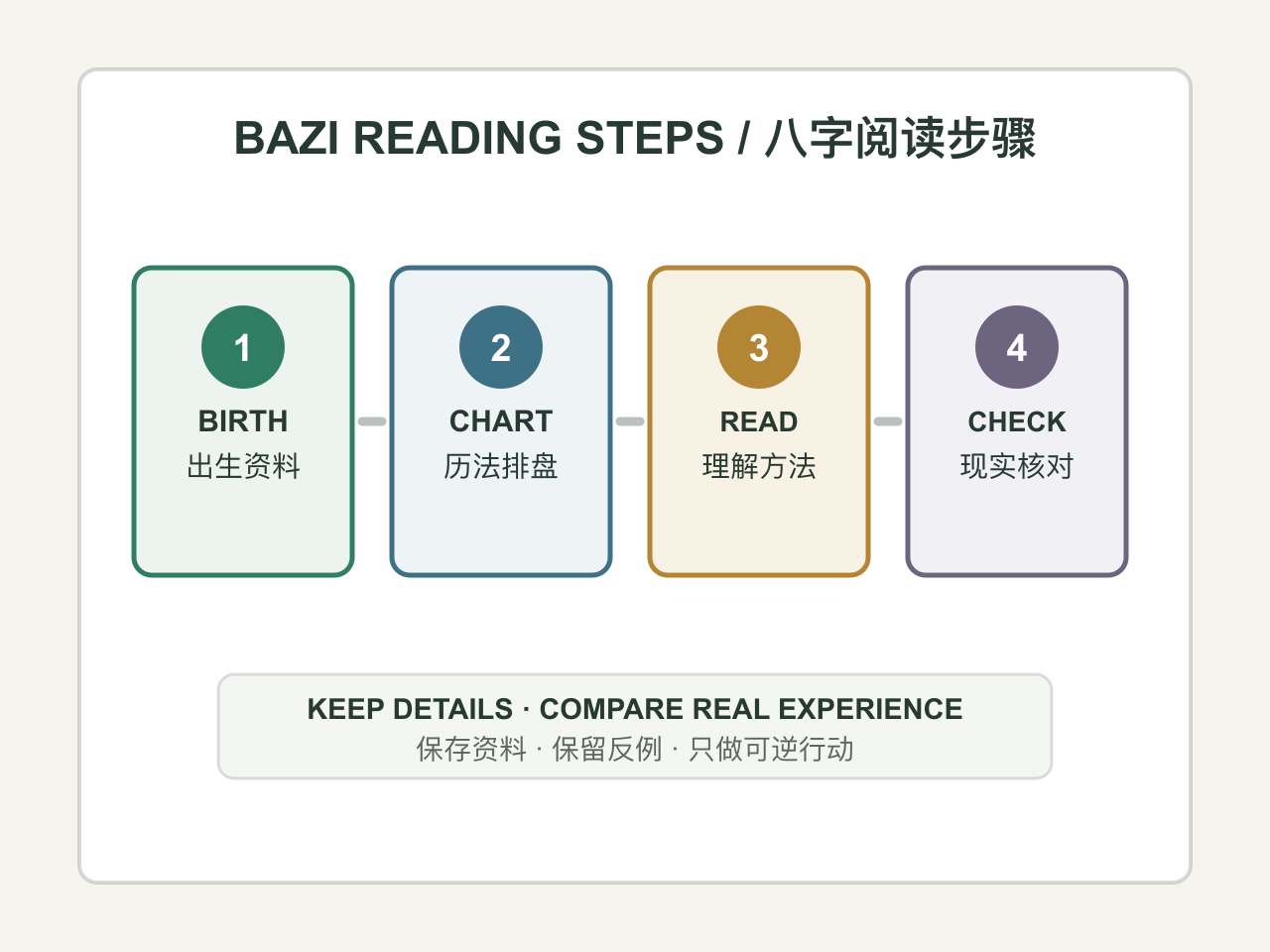
BaZi review path from birth input and chart calculation to method disclosure and real-world review

BaZi

BaZi Relationship Comparison Worksheet

Compare two anonymous birth profiles with the traditional rules explained on this page, then turn the result into questions about communication, expectations, boundaries, and uncertainty rather than predicting relationship outcomes.

Before you start

Prepare these details to see these results

Check which details are required before entering personal information. If something is missing, the page explains the effect instead of guessing for you.

What to prepare

  1. 1

    Person A birth date

    Establishes the calendar and timing data used by the calculation.

  2. 2

    Person B birth date

    Establishes the calendar and timing data used by the calculation.

What you will see

What you need before you start

This worksheet compares two anonymous birth profiles. Dates are required and times remain optional; it does not collect names or relationship status. Enter the second person's data only with permission.

Person A birth date

required

date required

Establishes the calendar and timing data used by the calculation.

Example: 1990-06-15

What to enter: Use a valid calendar date that is not in the future.

If you leave it out: The tool cannot produce a reliable result without this required value.
Person B birth date

required

date required

Establishes the calendar and timing data used by the calculation.

Example: 1990-06-15

What to enter: Use a valid calendar date that is not in the future.

If you leave it out: The tool cannot produce a reliable result without this required value.
How it works

This tool uses the details you enter on the page to produce a result. It is free to use, and your information is not sent to a third-party AI service.

How the traditional-rule reference score is calculated

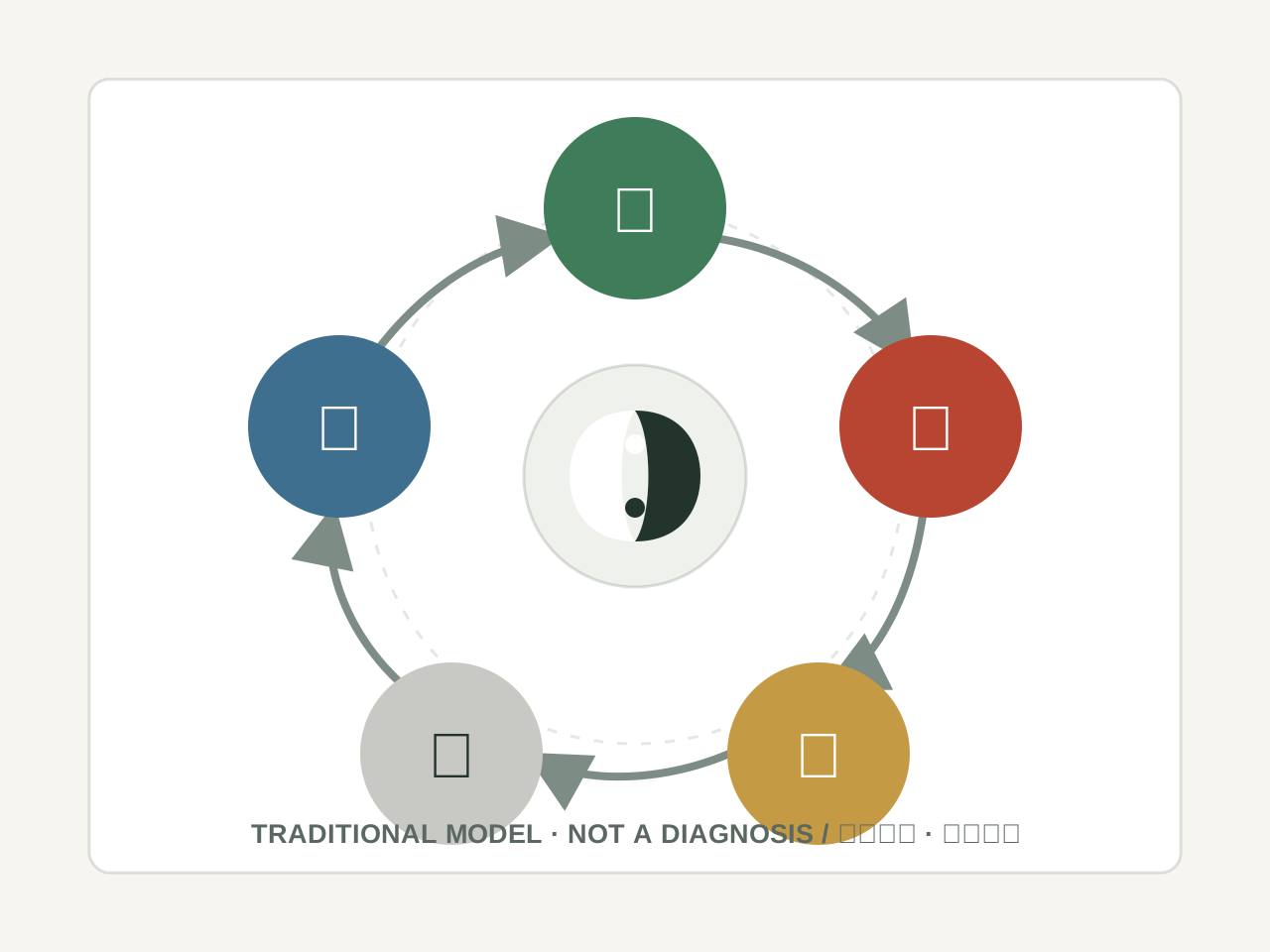
The reference score comes from the fixed traditional relations listed on this page. It is not trained on relationship outcomes, has not been tested against real relationship data, and must not be read as a probability of compatibility, marriage, separation, or safety.

The calculation begins at 70, applies only the Day Master and year-pillar relations below, and displays a result from 50 to 95. Names, gender, relationship stage, income, appearance, and private behavior do not change the score.

Traditional relationScore changeWhat is actually compared
Same Day Master element+8The element assigned to each day stem is the same
Day Master elements generate one another+15Either element precedes the other in the traditional generating cycle
Day Master elements control one another-12Either element precedes the other in the traditional controlling cycle
Year stem combination or year branch Six Harmony+6The year-pillar pair appears in a fixed traditional lookup set
Year branch clash-8The year branches appear in the fixed Six Clashes lookup set

Four discussion-topic reference scores

These four values summarize only the traditional relations listed here. They do not measure communication, collaboration, money behavior, caregiving, fertility, or relationship quality. Every value remains within the stated range after the listed additions and deductions.

The labels organize discussion only. Real behavior, consent, safety, values, responsibilities, financial records, and conflict repair take priority over every reference score.

Discussion topicStarting value and rulesDisplay range
InteractionStart 60; +25 generating Day Masters; +15 same element; -10 controlling relation; +10 year harmony40-100
CollaborationStart 65; +15 without year clash; +12 year harmony; +8 generating or same Day Masters45-100
ResourcesStart 60; +20 when both element spreads are at most 2, otherwise +10 when either spread is at most 3; +10 generating Day Masters45-100
CaregivingStart 65; +15 month-branch harmony; +10 without a month-branch clash45-100

What the worksheet actually uses

The calculation uses the two visible Day Master elements, selected year-stem and year-branch lookup pairs, visible element-count spreads, and the two month branches. It does not calculate Ten Gods relationship roles, spouse palaces, attachment style, intent, consent, safety, fertility, or future timing.

When either birth time is unknown, the hour pillar is omitted. The page keeps that uncertainty visible, but even complete birth details cannot turn a traditional chart comparison into a measurement of relationship quality.

Turn each label into a question with real evidence

Use the four labels only to organize a conversation, then answer them without relying on the chart.

  • Interaction: choose one recent disagreement and record what each person said, heard, needed, and did next.
  • Collaboration: list one shared responsibility, its owner, deadline, and what happens when a commitment cannot be met.
  • Resources: compare an actual budget, debt, risk limit, and disclosure expectation; the reference score uses no financial data.
  • Caregiving: discuss whether either person wants a caregiving role, what capacity exists, and which family boundaries require consent.
  • Safety: any coercion, control, fear, or harm overrides the worksheet and requires appropriate real-world support.

Run a 30-day relationship review

Select one discussion question and one observable agreement. Record the starting problem, both people's wording, the action, consent, review date, supporting evidence, and counterevidence. Do not ask one partner to accept a chart label as a fact about them.

After 30 days, mark the agreement keep, revise, or stop. A change in real communication does not prove the reference score accurate; it only shows whether the agreed action helped during that period.

When this worksheet is not the right tool

Do not use a reference score to decide whether someone is trustworthy, whether to marry or separate, whether to have children, or whether unsafe behavior should be tolerated. Enter another person's birth details only with permission.

Relationship safety, legal rights, housing, immigration, money, mental health, and medical decisions require direct evidence and qualified support from the relevant domain. A second chart calculation cannot resolve those issues.

Reading a relationship comparison

The comparison uses two sets of birth information to organise traditional relationship categories. It does not measure affection, consent, communication skill, or the future of a relationship. Read each output as a prompt for questions about expectations, boundaries, conflict habits, and practical plans.

Before using the result, agree that both people can discuss it without pressure. Do not show a score as proof that a relationship must continue or end. A useful follow-up is to compare the symbolic discussion with an ordinary conversation about money, time, family roles, privacy, and conflict repair. For bazi marriage, verify the displayed inputs and method notes before sharing the result.

  • Check the specific issue described in “Reading a relationship comparison” before changing the arrangement or interpretation.
  • Keep the action reversible and record what evidence would change the decision.

A practical review step

After opening this tool, write down the inputs and the question before reading the result. For reading a relationship comparison, distinguish what the calculation displays from what the explanatory language adds. If a term is unfamiliar, look it up in the related guide rather than treating it as self-explanatory.

Then choose one low-risk, independently reasonable next step and define when you will review it. If the recommendation would still make sense without the symbolic interpretation, it is more likely to be proportionate. For bazi marriage, verify the displayed inputs and method notes before sharing the result.

  • Check the specific issue described in “A practical review step” before changing the arrangement or interpretation.
  • Keep the action reversible and record what evidence would change the decision.

Limits and reader control

The page is designed to explain a traditional method, not to create urgency or dependence. Readers may disagree with an interpretation, seek another view, or stop after the calculation. No result should be used to pressure another person or to justify an irreversible choice.

Keep the original input and method visible when sharing a result. This makes the discussion easier to correct and prevents a short label from being presented as a complete account of a person or situation. For bazi marriage, verify the displayed inputs and method notes before sharing the result.

  • Check the specific issue described in “Limits and reader control” before changing the arrangement or interpretation.
  • Keep the action reversible and record what evidence would change the decision.

Read the comparison as a conversation aid

This tool organises two sets of birth information through a traditional comparison framework. The output cannot measure care, consent, honesty, conflict skills, finances, or whether either person feels safe. Before using it, agree that both people may disagree with the interpretation and that no score or label will be used to pressure the other person.

A useful reading turns each category into a conversation question: How do we handle time apart? Which financial expectations are unstated? How do we repair an argument? What boundaries do we need with relatives? Those questions have value whether or not the traditional comparison feels persuasive. For bazi marriage, verify the displayed inputs and method notes before sharing the result.

  • Check the specific issue described in “Read the comparison as a conversation aid” before changing the arrangement or interpretation.
  • Keep the action reversible and record what evidence would change the decision.

A responsible couple review

Write the result beside ordinary information about the relationship, not above it. Compare communication habits, shared plans, money arrangements, privacy, division of work, and how each person responds to stress. If the symbolic output conflicts with lived evidence, give the lived evidence priority.

Never use a relationship tool to diagnose abuse, justify surveillance, or make a decision on behalf of another adult. If there is coercion or danger, seek appropriate support. The safest use of the page is reflective, voluntary, and reversible. For bazi marriage, verify the displayed inputs and method notes before sharing the result.

  • Check the specific issue described in “A responsible couple review” before changing the arrangement or interpretation.
  • Keep the action reversible and record what evidence would change the decision.

A final checklist before discussing the comparison

Use this tool page as a starting point for a specific question. Write down the information you already know, the information you still need, and the practical decision that must remain yours. Then identify one assumption that could be wrong and one ordinary explanation that should be checked. This small pause makes the reading more transparent and gives the material a useful place in an actual situation.

Before acting, compare cost, reversibility, safety, and consent. A symbolic interpretation should not pressure you to spend money, change a shared space without agreement, or ignore professional advice. Keep a short record of what you expected, what you did independently, and what you later observed. A reader can value traditional knowledge while remaining free to question, postpone, or reject an interpretation. For bazi marriage, verify the displayed inputs and method notes before sharing the result.

  • Check the specific issue described in “A final checklist before discussing the comparison” before changing the arrangement or interpretation.
  • Keep the action reversible and record what evidence would change the decision.

A final case note

A final lesson note about BaZi Relationship Comparison Worksheet should connect the named method with a concrete case. Preserve the input, source, date, convention, and uncertainty, then describe the ordinary situation before applying specialist vocabulary. Compare the traditional interpretation with one practical explanation and state which conclusion remains unproven.

Use one small reversible exercise and set a review date. Record cost, consent, affected people, and what actually changed, including inconvenient results. If the topic touches health, money, law, safety, work, or relationship boundaries, use the relevant professional or shared process. The method supports cultural learning and reflection; it does not guarantee an outcome.

What does the report focus on?

The report documents the two calculated profiles, compares a declared set of five-element and branch relationships, and turns the result into discussion prompts about communication, expectations, boundaries, and uncertainty.

Can I use it without birth time?

Yes. Birth time improves detail, but you can leave it unknown and still generate a preview.

How should two people review a low compatibility score?

Treat the score as a prompt, not a verdict. Verify the birth inputs, read the separate communication and lifestyle factors, and discuss one real example together. A relationship cannot be accepted or rejected by a chart score, and concerns about safety or coercion require qualified support rather than another calculation.

Keep reading

Related articles

Try next

Related tools