The accuracy question is the wrong question to start with
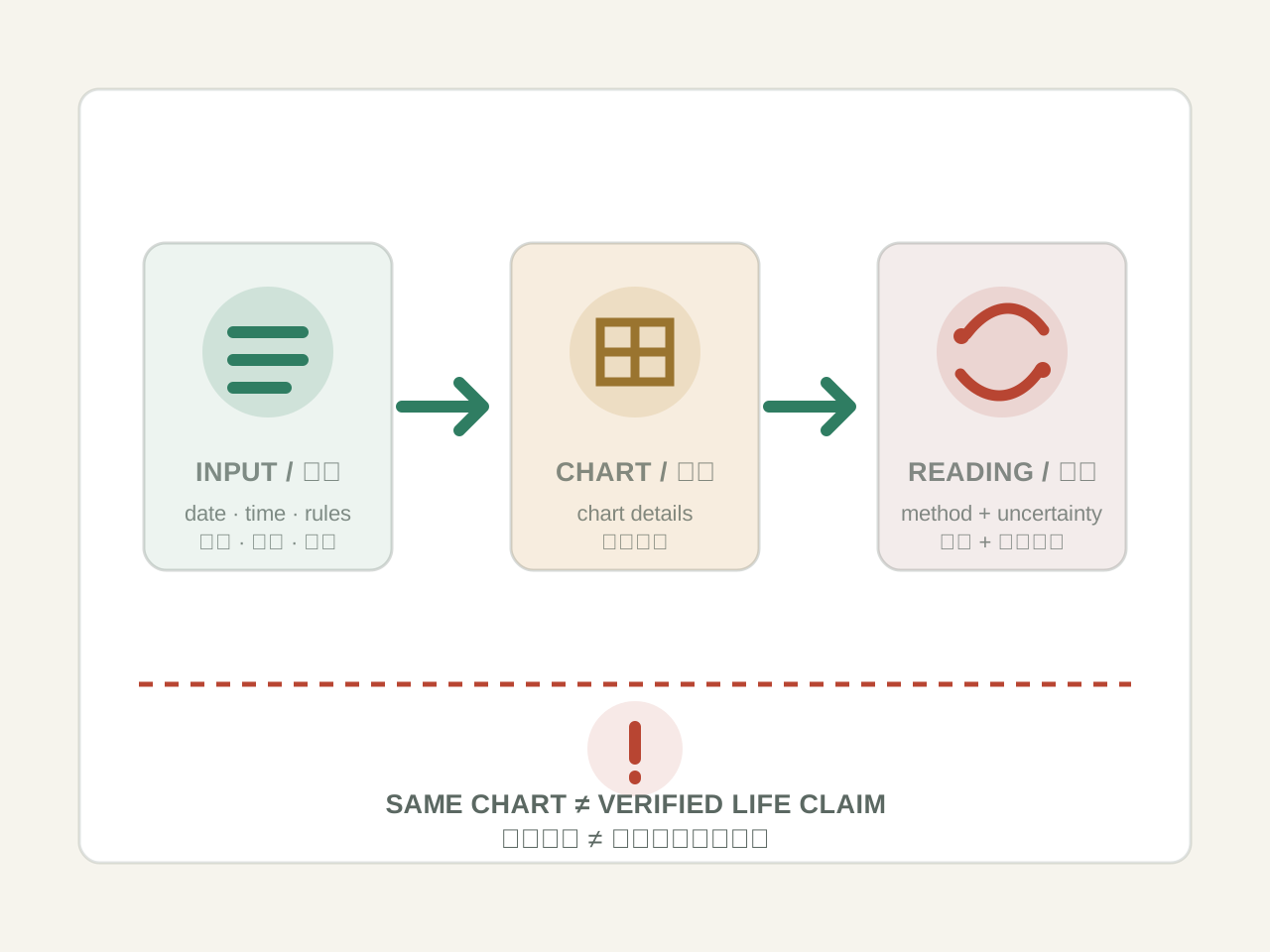
People often ask: 'Is BaZi fortune telling accurate?' That question combines two different things. A calculator can reproducibly convert a declared birth date and time into four stem-branch pillars. A reader then applies a chosen traditional method to those fields. Agreement on the calculation does not establish that a later statement about personality, compatibility, health, wealth, or a future event is true.
BaZi is a historical Chinese divination and interpretation tradition. Texts such as Yuanhai Ziping (渊海子平) and Sanming Tonghui (三命通会) document terminology and methods that later readers can compare. Their historical importance does not supply empirical validation, and citing them cannot turn a cultural interpretation into a measured personal fact.
A more useful audit asks three narrower questions: can the chart be reproduced from the stated input and boundary rules, is the interpretation method visible, and what independent evidence could support or contradict the personal claim?
How BaZi generates its readings — and where the variability comes from
A BaZi reading is produced by layering several analytical frameworks onto a birth chart. Each layer introduces interpretation and judgment, which means the same chart can produce different readings depending on who is doing the analysis. Here is a breakdown:
| Analysis layer | What it examines | Source of variability |
|---|---|---|
| Day Master strength | Whether the day-stem element is strong or weak relative to the birth season and surrounding stems/branches | Different schools use different weighting rules for support from earthly branches. One reader may classify a day master as 'strong', another as 'moderate'. This fundamentally changes the entire reading |
| Favorable and unfavorable elements | Which elements the chart needs more of and which it has too much of | The 'useful god' (用神) is the most debated concept in BaZi. Classical texts give principles, but the determination is ultimately a judgment call. Two skilled readers can disagree on the useful god of the same chart |
| Ten Gods analysis | The relationship between the day master and every other stem in the chart, categorised into ten archetypes | The Ten Gods are well-defined, but their interpretation depends on context. An 'Indirect Wealth' star in a strong chart means something different from the same star in a weak chart. Interaction effects multiply the complexity |
| Luck pillars (大运) | A sequence derived from the month pillar and a stated direction and start-age convention | Calculators can differ on direction, the solar-term interval used for start age, rounding, and boundary handling. Interpretation adds another layer of disagreement |
| Annual influence (流年) | The current year's stem and branch interacting with the natal chart and current luck pillar | Annual analysis is the most speculative layer. A year stem/branch creates dozens of possible interactions with the natal chart and luck pillar. Different readers will emphasise different interactions |
| Special structures and combinations | Whether the chart forms any of the classical patterns (e.g., 从格 follower structure, 化格 transformation structure) | Classical pattern recognition is the most disputed area. Some schools recognise patterns that others reject. A chart that one reader sees as a rare 'follower' structure may be read as a standard 'strong day master' chart by another |
What BaZi can organize without proving a personal claim
The strongest outputs are records of calculation and method. Reflection may follow, but the chart does not validate the reflection:
- A chart record that can be checked again. When the calendar, time zone, solar-term, day-boundary, and hour rules are stated, a tool can show the four pillars and conversion steps so another reader can check them with the same details. Getting the same chart does not validate a personality or future claim.
- A comparison of documented methods. Readers can show how they weight season, roots, hidden stems, combinations, useful god, Ten Gods, luck pillars, and annual interactions. Disagreement should remain visible rather than being hidden behind one confident answer.
- A set of reflection questions. Element or Ten-God language can prompt a user to examine planning, expression, support, boundaries, or timing. Write one observation that supports each interpretation and one that contradicts it; do not convert the prompt into a trait diagnosis.
- An audit trail for later review. Record the input uncertainty, rule version, interpretation, real decision made independently of the chart, and later outcome. This helps reveal vague fit, selective memory, and changing explanations; it does not turn anecdotal matches into validation.
What BaZi cannot tell you
Being clear about the limits is more important than listing the possibilities. Here is what BaZi cannot do:
- Predict specific events. BaZi cannot tell you whether you will get a particular job, marry a specific person, or experience a specific health issue on a specific date. The system describes elemental environments, not concrete outcomes. Two people born at the same moment in the same city will have the same BaZi chart — but they will live completely different lives because their families, education, choices, and circumstances differ.
- Replace medical, legal, or financial advice. No BaZi reading should influence your health decisions, legal strategy, or financial planning. If a practitioner tells you to delay medical treatment based on a BaZi analysis, walk away. The same applies to investment decisions, legal matters, and any situation where real-world expertise is required.
- Guarantee outcomes. Any practitioner who promises that a specific result will occur — 'you will become wealthy at age 35', 'you will marry in the year of the Dragon' — is making claims that BaZi as a system cannot support. The system describes tendencies and environments, not guarantees. Be sceptical of anyone who presents BaZi readings as certainties.
- Override personal agency. Your BaZi chart does not determine your choices. A person with a 'weak' chart can achieve extraordinary things through effort, learning, and adaptation. A person with a 'strong' chart can waste their advantages through poor decisions. The chart is a starting point, not a script.
A boundary example: ten minutes change the chart
Using the calendar rules stated on this page, 15 June 1990 at 22:50 produces 庚午 壬午 辛亥 己亥. The same civil date at 23:10 produces 庚午 壬午 壬子 庚子 because the day pillar changes at 23:00. The ten-minute difference changes both the Day Master and the hour pillar.
Another calculator may change the day at midnight, convert from a historical time zone, or apply a location-based correction. That does not make one result automatically authoritative. Save the birthplace, local clock time, time-zone and daylight-saving evidence, and day-boundary method before comparing the two charts.
Now separate calculation from interpretation. The first record has a Xin-Metal Day Master; the second has a Ren-Water Day Master. A reader may attach very different themes to them, but neither record establishes a trait or event. If the original time is only 'around 23:00', the honest result is two candidate charts and fewer time-dependent claims.
Another reader can enter both times and identify exactly where the results begin to differ. This is more useful evidence than a polished life story whose underlying chart has never been checked.
How to use BaZi readings without being misled
If you decide to consult a BaZi reader or use BaZi tools, here are practical guidelines:
- Verify the birth record. Hour-dependent chart details change across two-hour branches, and the day pillar can also change near the calculator's day boundary. Check a birth certificate or other reliable record where available. If the time remains uncertain, preserve every plausible chart and reduce the detail instead of choosing the most convincing story.
- Demand a method, not a frightening verdict. If a reader claims 'poor luck' or 'difficult fate', ask which input, boundary rule, chart field, and interpretive convention produced the statement, and what evidence would count against it. Do not make a consequential decision from a negative label or buy a remedy under pressure.
- Treat BaZi as a conversation, not a verdict. The best BaZi readings feel like a discussion about your tendencies and possibilities, not a pronouncement about your future. If a reader speaks in certainties, treats the chart as destiny, or discourages questions, find a different reader.
- Separate cultural services from outcome claims. A consultation, book, ritual, or object may have cultural or personal meaning, but no seller can show from a chart that an expensive purchase will repair health, wealth, relationships, or fate. Refuse urgency, guarantees, hidden recurring charges, and any offer that discourages independent advice.
The honest limit
BaZi is a historically important cultural system with documented calculation and interpretation traditions. Its chart fields can be reproduced when the input and rules are explicit, but its personal and predictive claims have not been empirically validated. Use it for cultural study or structured reflection, keep competing explanations and contrary evidence visible, and refuse anyone who presents a reading as a precise measurement of your character or future. Consequential choices still depend on your circumstances, records, consent, and qualified advice from the relevant real-world domain.
What accuracy would require
A claim about accuracy needs more than a memorable match. It requires a reproducible input, a declared calculation method, a clear interpretation made before the outcome, and a way to record misses as well as hits. If the wording is vague enough to fit many outcomes, apparent accuracy cannot distinguish a useful method from selective memory.
Readers should ask whether the birth time, timezone, calendar conversion, solar-term boundary, hidden stems, and weighting rules were declared. Two practitioners can use the same chart and reach different conclusions; that variation is part of the method’s limitation, not something to hide.
- Check the specific issue described in “What accuracy would require” before changing the arrangement or interpretation.
- Keep the action reversible and record what evidence would change the decision.
A fair personal test
If someone wants to evaluate a reading, write specific statements with a time window before events occur. Avoid health, legal, financial, or safety decisions. Later, compare the statement with the actual record and include counterexamples. Do not change the interpretation after the fact to make it fit.
A reflective reading may still feel meaningful because it helps a person organise questions or notice a pattern in their choices. That value is different from scientific prediction. Keeping the categories separate allows appreciation without overstating certainty.
- Check the specific issue described in “A fair personal test” before changing the arrangement or interpretation.
- Keep the action reversible and record what evidence would change the decision.
Questions for a responsible reader
Ask what the reading can change in practice, whether the proposed action is reversible, and whether a qualified professional should be consulted. Be cautious when a reader is told that fear, urgency, or payment is necessary to avoid a result. No chart should be used to remove another person’s agency or to make a major decision without ordinary evidence.
The honest conclusion is usually conditional: traditional systems offer interpretive frameworks, while their predictive accuracy is difficult to establish and varies by method. A careful reader can study the tradition and still remain responsible for independent decisions.
- Check the specific issue described in “Questions for a responsible reader” before changing the arrangement or interpretation.
- Keep the action reversible and record what evidence would change the decision.
A concrete reader question
A useful way to read Is BaZi Fortune Telling Accurate? is to begin with a concrete question rather than a general promise. The page describes examine how birth-data quality, chart rules, school differences, and the barnum effect shape the perceived accuracy of a bazi reading. A reader should write down what they want to understand, what information they already have, and what decision still belongs to them. If the question concerns a room, include the people who use it, the route through it, light, sound, maintenance, privacy, and safety. If it concerns a chart, date, symbol, name, dream, face, or palm, preserve the input, source, calendar or dictionary rule, and any uncertainty. This makes the topic specific enough to review instead of allowing a familiar term to stand in for an explanation.
Separate three layers in the notes: what the tradition means, what can be observed now, and what action is practical. A cultural association can be worth studying without being a verified prediction. The distinction is especially important when the topic sounds personal or consequential.
A worked comparison
Use one ordinary case related to Is BaZi Fortune Telling Accurate?. Describe the situation in plain language before applying specialist vocabulary. Then compare two possible readings or actions in a table: input, method, expected implication, observable evidence, cost, risk, affected people, reversibility, and review date. If the topic involves a proposed arrangement, compare access, lighting, noise, comfort, cleaning, privacy, and shared agreement. If it involves a calculation or interpretation, compare the calendar, time boundary, source, school, dictionary, or weighting rule.
Do not hide a disagreement by averaging incompatible methods. State which conclusion changes under which assumption. Write one ordinary explanation beside the traditional one: workload, sleep, communication, budget, maintenance, camera angle, weather, or a simple input error may explain the same experience. A fair comparison makes room for curiosity and correction.
A low-risk next step
Choose one modest next step connected to Is BaZi Fortune Telling Accurate?. Check a source, repeat a measurement, ask the person affected, observe the space at another time, compare two declared inputs, or keep a short record for a defined period. Change only one condition. Before acting, record the baseline and obtain consent if another person or shared space is involved. Avoid structural work, large purchases, or irreversible decisions until the practical issue is understood and the appropriate professional advice has been considered.
Review the result without treating sequence as proof of cause. Record what improved, what became harder, and what did not change. If a practical adjustment helps, acknowledge ordinary reasons that may have contributed. If it fails, undo or revise it rather than escalating automatically or blaming the reader. The value of a small test is that it can change the question.
Sources and limits
A reader should be able to see where the explanation comes from. Record the source, author or tradition, date accessed, terminology, and method used for Is BaZi Fortune Telling Accurate?. Mark whether a statement is historical description, practitioner interpretation, direct observation, or practical advice. These categories should not be blended into a claim of scientific certainty. When two sources use the same word differently, preserve both definitions and explain which one this page follows.
The page is cultural and reflective material. It cannot diagnose illness, guarantee income, determine a person’s fixed character, prove relationship compatibility, replace legal or financial advice, or override safety and consent. Use proportionate language such as traditionally associated, one school interprets, or this input may suggest. Clear limits increase usefulness rather than weakening it.
A review record for future readers
Close a study of Is BaZi Fortune Telling Accurate? with a record another reader could understand months later: original question, inputs, source, method, interpretation, ordinary explanation, action, cost, affected people, observed result, and next review date. Include evidence that did not fit the preferred explanation. If the original input was uncertain, do not rewrite it after the result is known. This preserves the difference between what was known at the beginning and what was learned later.
The reader remains free to disagree, seek another source, postpone action, or stop. If the issue involves health, safety, law, money, employment, structural work, or relationship coercion, use the relevant professional or shared process. The strongest conclusion is often a clearer question and a reversible next step, not a dramatic promise.
Disclaimer: This content is for informational and cultural reference purposes only. It does not constitute professional medical, legal, financial, or psychological advice. Readers should exercise their own judgment and consult qualified professionals for specific concerns.
Sources and review basis
Traditional references explain historical vocabulary and context. Official practical sources support only the observable safety, comfort, or environmental points noted in the article; they do not validate metaphysical claims.
Traditional reference
Yuanhai Ziping (渊海子平)Wikisource digital text · Accessed 2026-07-14
A classical source for Four Pillars terminology, element relationships, and the Day Master framework.
Traditional reference
Sanming Tonghui (三命通会)Wikisource digital text · Accessed 2026-07-14
A historical compilation used to cross-check traditional BaZi concepts; it is not scientific validation.
Practical source
APA Dictionary of Psychology: Barnum effectAmerican Psychological Association · Accessed 2026-07-14
A psychology reference for why broad, favourable personality descriptions can feel personally accurate. It does not evaluate BaZi calculations themselves.